Lyme disease is the most common tick-borne illness in the United States, with the CDC estimating about 476,000 Americans diagnosed and treated each year. It is caused by the bacterium Borrelia burgdorferi (and, less commonly, Borrelia mayonii), transmitted by infected blacklegged ticks — Ixodes scapularis in the eastern and midwestern U.S. and Ixodes pacificus on the West Coast.
Most cases are concentrated in the Northeast, mid-Atlantic, and upper Midwest, with steady expansion as tick ranges shift. Caught early, Lyme is highly treatable with a short course of oral antibiotics. Caught late or untreated, it can cause neurological, cardiac, and joint complications that are harder to reverse.
When to seek in-person or emergency care, not telehealth
- Facial drooping or weakness on one side — Lyme can cause cranial nerve palsy; needs urgent evaluation to rule out stroke and start treatment
- Severe headache, stiff neck, fever, light sensitivity — possible Lyme meningitis
- Chest pain, palpitations, shortness of breath, or fainting — possible Lyme carditis (heart block can be life-threatening)
- Numbness, tingling, weakness in limbs — neurologic Lyme
- Severely swollen joint with high fever — rule out septic arthritis
The Three Stages of Lyme Disease
Lyme progresses in stages if not treated. Understanding which stage you are in determines the antibiotic, duration, and whether telehealth or in-person care is appropriate.
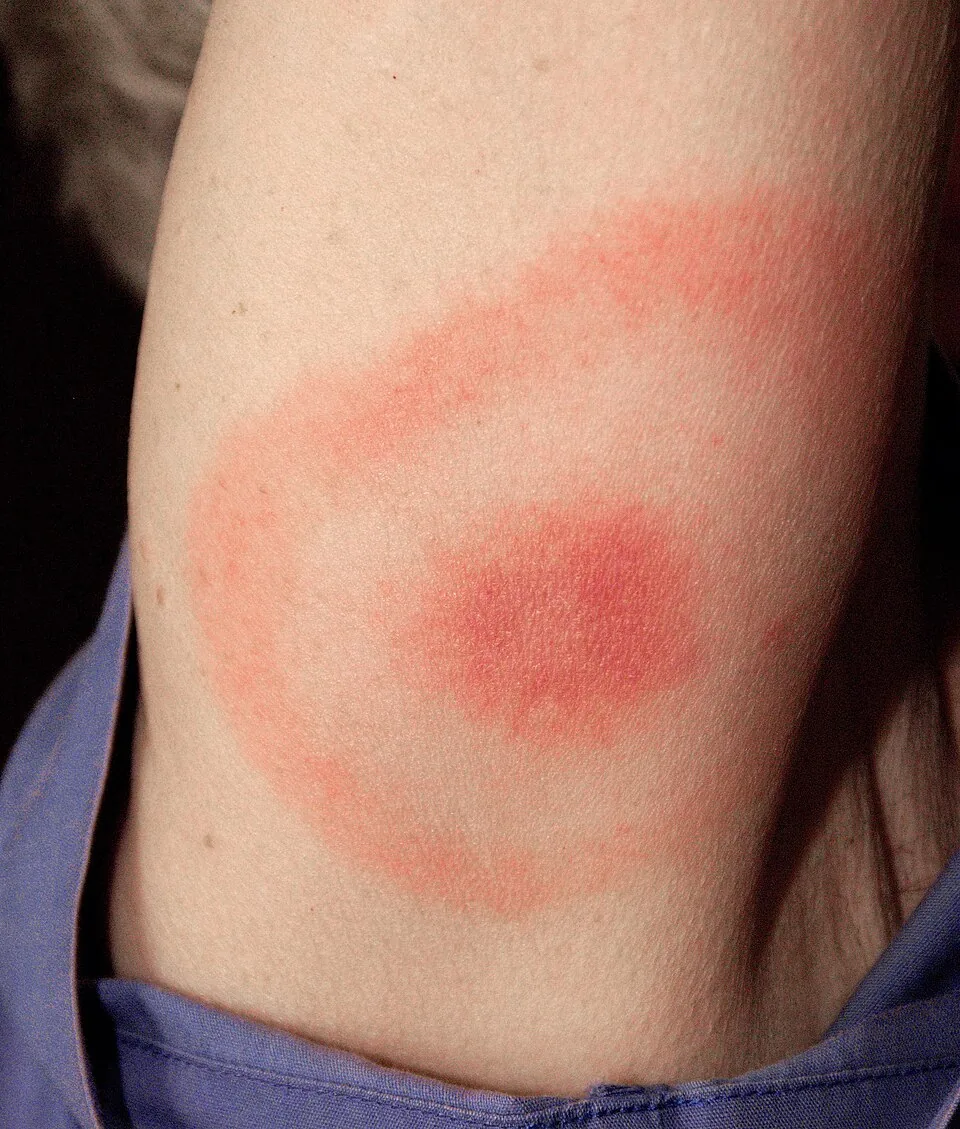
- Stage 1: Early Localized (days to 30 days after the bite). The classic presentation is the erythema migrans (EM) rash — an expanding red, sometimes target-shaped lesion at the bite site, usually 5 cm or larger. Most people also have flu-like symptoms: fatigue, headache, mild fever, achy muscles, swollen lymph nodes. About 70 to 80 percent of patients develop the EM rash; the rest never do.
- Stage 2: Early Disseminated (weeks to months). The bacteria spread through the bloodstream. Multiple EM rashes can appear on different parts of the body. Patients may develop facial palsy (Bell's-palsy-like droop), Lyme carditis (heart block), or neurologic symptoms (meningitis, radiculopathy). This stage requires urgent in-person evaluation.
- Stage 3: Late Disseminated (months to years). The most common late manifestation in the U.S. is Lyme arthritis — intermittent or persistent swelling of one or two large joints, especially the knee. Neurologic symptoms (cognitive complaints, peripheral neuropathy) can also occur. Diagnosis at this stage typically requires serology and often specialist input.
Diagnosis: Clinical vs. Laboratory
If you have a classic EM rash and a plausible tick exposure, the CDC recommends treating clinically — lab testing is NOT required and is often falsely negative in early disease because antibodies have not developed yet.
For non-classic presentations (no remembered tick bite, no EM rash, or later-stage symptoms), the CDC recommends a two-tier serology approach:
- Tier 1: An enzyme immunoassay (EIA) or immunofluorescence assay (IFA).
- Tier 2: If tier 1 is positive or equivocal, either a Western blot (traditional) or a second EIA (modified two-tier testing, also CDC-approved).
Important: antibodies take 2–6 weeks to develop after infection, so testing too early gives a false negative. If you have a classic EM rash, do not wait for serology — treat now.
Antibiotic Treatment by Stage
The IDSA, AAN, and ACR jointly updated Lyme treatment guidelines in 2020. The current standards:
- Early localized Lyme (EM rash, no neurologic or cardiac signs). A short course of doxycycline (100 mg twice daily for 10 days in adults) is the preferred first-line treatment at ANY age — the 2020 IDSA/AAN/ACR guidelines removed the old age-8 restriction, having found that short courses pose minimal risk of dental staining in younger children. Amoxicillin (500 mg three times daily for 14 days) and cefuroxime axetil (500 mg twice daily for 14 days) remain acceptable alternatives, and are preferred in pregnancy.
- Multiple EM rashes (early disseminated, no neurologic involvement). Same oral regimens as above, typically 14 days.
- Lyme arthritis (no neurologic involvement). Doxycycline 100 mg twice daily for 28 days, or amoxicillin/cefuroxime if doxycycline is not appropriate.
- Lyme carditis or neurologic Lyme (meningitis, radiculopathy). Hospital admission and IV ceftriaxone in most cases — not telehealth-appropriate.
- Cranial nerve palsy (e.g., facial palsy) without other CNS involvement. Oral doxycycline 100 mg twice daily for 14–21 days is now accepted under the 2020 guidelines, but in-person evaluation is needed first.
Most people start to feel better within a few days of starting antibiotics, though full recovery from fatigue and joint symptoms can take weeks.
Post-Treatment Lyme Disease Syndrome (PTLDS)
About 5 to 20 percent of patients treated for Lyme disease report persistent fatigue, musculoskeletal pain, or cognitive symptoms beyond six months after appropriate antibiotic treatment. This is called Post-Treatment Lyme Disease Syndrome (PTLDS). Multiple randomized trials have shown that prolonged or repeated courses of antibiotics do not improve symptoms and carry real risks (resistant infections, IV-line complications). PTLDS is real but is not the same as ongoing infection, and the IDSA recommends supportive care — pain management, graded exercise, sleep optimization, and treating any co-occurring conditions — rather than long antibiotic courses.
Prevention: The Best Treatment
- Repellent. DEET (20–30%) on exposed skin, or permethrin treatment on clothing and gear (lasts through multiple washes).
- Clothing. Light-colored long sleeves and pants when walking through grassy or wooded areas; tuck pants into socks.
- Tick checks. Within 2 hours of coming inside, check carefully — especially scalp, behind ears, armpits, groin, behind knees, navel.
- Prompt removal. Use fine-tipped tweezers, grasp close to the skin, pull straight up. The risk of transmission rises sharply after the tick has been attached 36 hours.
- Post-exposure prophylaxis. A single dose of doxycycline 200 mg within 72 hours of removing an attached blacklegged tick in an endemic area is recommended in some scenarios. Ask a provider promptly.
When Telehealth Is Appropriate
Telehealth is well-suited to early localized Lyme — the classic EM rash is highly visible on camera, the diagnosis is largely clinical, and the treatment is a straightforward antibiotic prescription. InnoCre can also handle post-exposure prophylaxis decisions, follow-up after treatment, and serology ordering for non-classic cases.
When You Need an In-Person Visit Instead
- Any neurologic symptom (facial droop, numbness, severe headache)
- Cardiac symptoms (palpitations, chest pain, fainting)
- Severe joint swelling, especially with fever (rule out septic arthritis)
- Confirmed Lyme with persistent symptoms after first treatment course
- Pregnancy — preferable to coordinate with your obstetric provider
Bottom line. Early-stage Lyme — classic EM rash within 30 days of a tick exposure — is one of the best telehealth conditions: visually obvious, clinically diagnosed, treated with 10 days of doxycycline. Disseminated or neurologic Lyme is not telehealth-appropriate. The strongest prevention is fast tick removal and good repellent use in endemic areas.
Ready to see a provider?
Book a same-day telehealth visit with a board-certified provider from home.
Book a Visit →Same-day visits · HSA/FSA accepted · Licensed in PA, MD, WA & DE
Atul S. Vellappally, DNP, CRNP, FNP-BC
Founder, InnoCre Telehealth. Board-certified Family Nurse Practitioner with doctoral-level training in evidence-based and precision medicine. Licensed in Pennsylvania, Maryland, Washington, and Delaware.
This article is for informational purposes only and does not constitute medical advice. If you are experiencing a medical emergency, call 911.
Related Articles
Sources
- Centers for Disease Control and Prevention (CDC). Lyme Disease. CDC Lyme Disease overview
- Lantos PM, Rumbaugh J, Bockenstedt LK, et al. Clinical Practice Guidelines by the Infectious Diseases Society of America (IDSA), American Academy of Neurology (AAN), and American College of Rheumatology (ACR): 2020 Guidelines for the Prevention, Diagnosis, and Treatment of Lyme Disease. Clinical Infectious Diseases. 2021;72(1):e1–e48.
- National Institute of Allergy and Infectious Diseases (NIAID). Lyme Disease. National Institutes of Health. NIAID Lyme Disease research summary
- Mayo Clinic. Lyme Disease — Diagnosis and Treatment. Mayo Clinic Lyme Disease diagnosis and treatment
- Nadelman RB, Nowakowski J, Fish D, et al. Prophylaxis with single-dose doxycycline for the prevention of Lyme disease after an Ixodes scapularis tick bite. New England Journal of Medicine. 2001;345(2):79–84.
- Mead PS. Epidemiology of Lyme disease. Infectious Disease Clinics of North America. 2015;29(2):187–210.
Related Services
Related Articles
Frequently Asked Questions
How soon after a tick bite should I see a healthcare provider?
If you find an attached tick, especially one that has been feeding for 36 hours or more, contact a provider promptly. A single dose of doxycycline given within 72 hours of tick removal can help prevent Lyme disease in certain situations. If you develop a rash, fever, or joint pain in the days or weeks after a bite, seek care right away.
What does the Lyme disease bull's-eye rash look like?
The classic erythema migrans rash begins as a red area at the tick bite site and expands over days to weeks, often forming a target-like or bull's-eye pattern with a central clearing. It typically reaches at least 5 centimeters in diameter. However, many Lyme rashes appear as a uniformly red or bluish-red oval patch without the central clearing, so any expanding rash after a tick bite should be evaluated.
Can Lyme disease be treated through telehealth?
Yes. A telehealth provider can evaluate photos of a rash, review your symptoms, assess your risk based on geographic exposure and tick attachment duration, and prescribe appropriate antibiotics such as doxycycline. Telehealth is well suited for initial evaluation, prophylaxis after a tick bite, and treatment of early Lyme disease.
What is the standard treatment for Lyme disease?
The standard treatment for early Lyme disease is a course of oral doxycycline, typically 100 mg twice daily for 10 to 21 days depending on the clinical presentation. Amoxicillin or cefuroxime axetil are alternatives for patients who cannot take doxycycline. Early treatment is highly effective, with most patients recovering fully.
Why might I still have symptoms after finishing Lyme disease treatment?
Some patients experience lingering fatigue, pain, or cognitive difficulties after completing appropriate antibiotic therapy. This is known as post-treatment Lyme disease syndrome (PTLDS). It is thought to result from residual inflammation rather than ongoing active infection. Symptoms typically improve gradually over weeks to months. Prolonged or repeated antibiotic courses have not been shown to provide additional benefit and carry risks.
Is Lyme disease common in Pennsylvania, Maryland, Washington, and Delaware?
Maryland and Delaware are both high-incidence Lyme disease states, with the blacklegged tick (Ixodes scapularis) widespread in wooded and grassy areas. Washington State has lower rates of Lyme disease overall, but the western blacklegged tick (Ixodes pacificus) does carry Borrelia burgdorferi in certain regions. Risk varies seasonally, with peak transmission in late spring and summer.
Should I save the tick after I remove it?
Saving the tick can be helpful but is not required for treatment decisions. If you keep it, place it in a sealed bag or container with a damp paper towel. Some labs offer tick testing, but the results do not change clinical management because not every infected tick transmits disease and not every bite from an uninfected tick is risk-free. Provider decisions are based on attachment time, symptoms, and your region.
How is Lyme disease diagnosed?
Early Lyme disease with a classic erythema migrans rash is diagnosed clinically without lab testing. For other presentations, a two-tier blood test is used: an initial ELISA or similar screening test followed by a Western blot or second-tier immunoassay if positive. Antibodies can take 2 to 6 weeks to develop, so testing too early after a bite may give a false negative.
Can I take doxycycline if I am pregnant or breastfeeding?
Doxycycline is generally avoided during pregnancy. Amoxicillin or cefuroxime axetil are preferred alternatives for treating Lyme disease in pregnancy. Short courses of doxycycline are considered compatible with breastfeeding. Always tell your provider if you are pregnant, planning pregnancy, or breastfeeding so the safest antibiotic can be selected.
How can I prevent tick bites in the first place?
Use EPA-registered repellents containing DEET, picaridin, or IR3535 on skin, and permethrin on clothing. Wear long pants tucked into socks when hiking in wooded or grassy areas, stay on cleared trails, and perform a thorough tick check on yourself, children, and pets within 2 hours of coming indoors. Showering soon after outdoor activity helps wash off unattached ticks.
How does an InnoCre telehealth visit work?
After you book, you complete a short intake form, then connect with a board-certified provider by video on the same day in most cases. The provider reviews your symptoms and history, orders lab work at a local lab if needed, and sends any prescription to the pharmacy of your choice. A new-patient visit is a flat $68 with no insurance required.