What STD testing involves, which tests you need, how often to get screened, and how to get tested online.
Need Care Today?
Get a same-day telehealth visit with a board-certified provider.
Licensed in PA, MD, WA & DE
Book a Visit →Why STD Testing Matters
Sexually transmitted diseases (STDs) are among the most common infectious diseases in the United States, with the CDC reporting millions of new infections each year. Many STDs produce no symptoms in their early stages, meaning you can be infected and unknowingly transmit the infection to partners without ever feeling sick. This is why routine screening is so important.
Undiagnosed and untreated STDs can lead to serious long-term health consequences. Chlamydia and gonorrhea, if left untreated, can cause pelvic inflammatory disease (PID) in women, leading to chronic pain, ectopic pregnancy, and infertility. Untreated syphilis can progress to affect the heart, brain, and other organs. HIV, when caught early and treated with antiretroviral therapy, is now a manageable chronic condition, but delayed diagnosis significantly worsens outcomes.
Regular STD testing protects both your own health and the health of your partners. Testing is confidential, straightforward, and more accessible than ever through telehealth services.
Who Should Get Tested
The CDC provides specific screening recommendations based on age, sex, and risk factors. Testing is recommended for:
- All sexually active women under 25: Annual screening for chlamydia and gonorrhea
- Women 25 and older: Annual screening if you have new or multiple sexual partners, or a partner with an STD
- All pregnant women: Screening for HIV, syphilis, hepatitis B, chlamydia, and gonorrhea early in pregnancy
- Sexually active men who have sex with men (MSM): At least annual screening for HIV, syphilis, chlamydia, and gonorrhea, with more frequent testing (every 3 to 6 months) for those with multiple partners
- Anyone with a new sexual partner: Testing before becoming sexually active with a new partner
- Anyone with symptoms: Unusual discharge, sores, burning during urination, or rashes in the genital area
- Everyone ages 13 to 64: At least one HIV test in their lifetime as part of routine healthcare
If you are unsure whether you need testing, a provider can assess your individual risk factors and recommend an appropriate screening plan during a confidential STD testing visit.
What a Standard Panel Includes
A comprehensive STD panel typically screens for the most common sexually transmitted infections. While the exact tests may vary based on your risk factors and provider recommendations, a standard panel generally includes:
- Chlamydia: Detected via nucleic acid amplification test (NAAT) from a urine sample or swab. Chlamydia is the most commonly reported STD in the U.S.
- Gonorrhea: Also detected via NAAT from urine or swab. Gonorrhea testing is usually performed alongside chlamydia.
- HIV: Detected via blood test (antibody/antigen test or rapid test). Fourth-generation tests can detect HIV as early as 2 to 4 weeks after exposure.
- Syphilis: Detected via blood test (RPR or VDRL screening, confirmed with treponemal testing).
- Hepatitis B: Blood test for surface antigen (HBsAg) and antibodies.
- Hepatitis C: Blood test for antibodies, recommended for all adults at least once.
Additional tests may be recommended based on individual circumstances, including herpes (HSV-1 and HSV-2) blood testing, trichomoniasis screening, and HPV testing for women during cervical cancer screening. Note that routine HSV blood (serology) testing is not recommended for people without symptoms, per the CDC and USPSTF. Your provider will customize the panel based on your specific risk profile.
How Testing Works
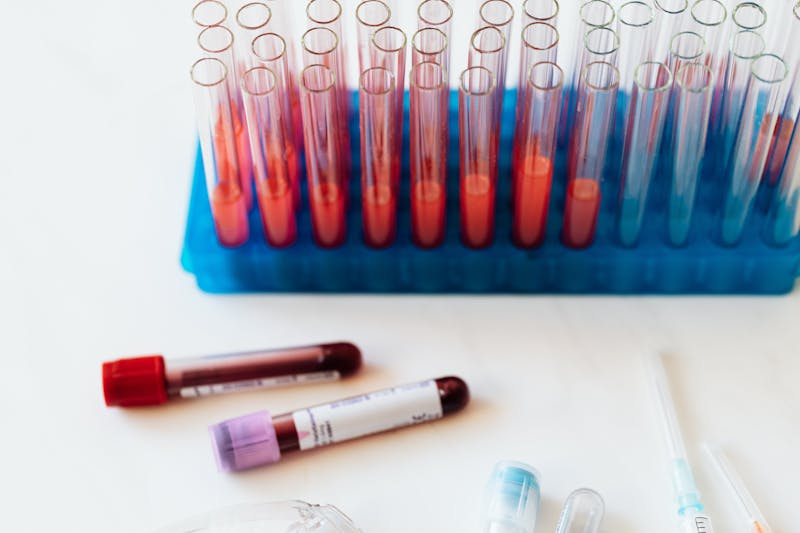
A standard STD panel tests for HIV, syphilis, chlamydia, gonorrhea, and hepatitis.
STD testing is simpler than most people expect. The process involves minimal discomfort and can usually be completed quickly at a lab near you. Here is what to expect:
Before the test: Your provider will discuss your sexual history, symptoms (if any), and risk factors. This conversation is confidential and judgment-free. Based on this assessment, they will determine which tests to order. No special preparation is typically required, though some tests work best if you have not urinated for at least one hour before providing a urine sample.
Sample collection: Depending on the tests ordered, you may need to provide one or more of the following:
- A urine sample (for chlamydia and gonorrhea)
- A blood draw (for HIV, syphilis, hepatitis B and C, herpes)
- A swab of any visible sores or lesions (if present)
- A throat or rectal swab (for pharyngeal or rectal gonorrhea/chlamydia, if indicated)
After the test: Most results are available within 1 to 5 business days. Rapid HIV tests can provide preliminary results in as little as 20 minutes. Your provider will contact you with results and discuss any necessary treatment or follow-up steps.
Understanding Your Results
STD test results are typically reported as either negative (no infection detected) or positive (infection detected). However, understanding results requires some important context:
Negative results mean the test did not detect the infection at the time of testing. However, if you were exposed very recently, you may be in the "window period" before the infection becomes detectable. Window periods vary by infection: chlamydia and gonorrhea NAAT tests are accurate as early as 1 to 2 weeks after exposure, while HIV antibody/antigen tests may take 2 to 4 weeks. Syphilis testing may require 3 to 6 weeks after exposure to turn positive. If you had a recent exposure, your provider may recommend repeat testing after the window period.
Positive results mean the infection was detected and treatment is needed. A positive result is not a reason to panic. Most common STDs are highly treatable, and many are curable with a single course of antibiotics. Your provider will explain your specific diagnosis, treatment options, the importance of partner notification, and any recommended follow-up testing to confirm the infection has cleared.
In some cases, confirmatory testing may be needed. For example, a positive syphilis screening test requires a second confirmatory test, and a reactive rapid HIV test is followed by a confirmatory laboratory test. Your provider will guide you through this process.
Getting Tested Through Telehealth
Telehealth has made STD testing more private, convenient, and accessible than ever. For many people, the stigma or embarrassment associated with visiting a clinic in person is a barrier to getting tested. A telehealth visit removes that barrier entirely, allowing you to discuss your concerns and receive lab orders from the privacy of your home.
Here is how the process works with InnoCre's STD testing service:
- Step 1: Book a confidential telehealth visit online. Same-day appointments are typically available.
- Step 2: Meet with your provider via secure video. Discuss your concerns, symptoms (if any), and risk factors.
- Step 3: Your provider orders the appropriate tests and sends a lab requisition to a convenient lab location near you.
- Step 4: Visit the lab at your convenience for sample collection (urine and/or blood draw).
- Step 5: Results are reviewed by your provider and discussed with you via a follow-up visit or secure message.
The entire process is HIPAA-compliant and confidential. Your results are shared only with you and your provider.
What Happens If You Test Positive
A positive STD result can feel overwhelming, but it is important to know that most STDs are treatable and many are completely curable. Here is what happens next:
Treatment: Your provider will prescribe the appropriate medication based on your diagnosis, following the current CDC STI Treatment Guidelines (2021, re-affirmed 2024). Chlamydia is typically treated with doxycycline 100 mg twice daily for seven days (azithromycin is an alternative in pregnancy). Gonorrhea is treated with a single intramuscular injection of ceftriaxone (500 mg for most adults; 1 g if weight is 150 kg or more), often combined with doxycycline when chlamydia co-infection has not been ruled out. Syphilis is treated with penicillin injections. For viral infections such as HIV or herpes, effective long-term management medications are available.
Partner notification: Sexual partners need to be informed so they can be tested and treated. This prevents reinfection and stops the chain of transmission. Your provider can offer guidance on how to have this conversation. Many health departments also offer anonymous partner notification services.
Follow-up testing: For uncomplicated genital chlamydia and gonorrhea, a test of cure is not routinely needed. Instead, a repeat test to check for reinfection is recommended about 3 months after treatment, because reinfection rates are high (CDC, 2021).
Prevention going forward: Your provider will discuss strategies to reduce future risk, including consistent condom use, reducing the number of sexual partners, and regular screening schedules. PrEP (pre-exposure prophylaxis) may be discussed for HIV prevention in appropriate candidates.
Frequently Asked Questions
What does a standard STD panel include?
A comprehensive STD panel typically tests for HIV, syphilis, chlamydia, gonorrhea, hepatitis B and C, and sometimes herpes and trichomoniasis. Your provider may recommend specific tests based on risk factors.
How often should you get tested for STDs?
The CDC recommends annual screening for sexually active individuals under 25 and for anyone with new or multiple partners. More frequent testing may be recommended based on risk factors.
Can you order STD tests through telehealth?
Yes. A telehealth provider can assess your risk, order appropriate tests, and send a lab requisition to a location near you. Results are reviewed and discussed via a follow-up visit.
How long does it take to get STD results?
Most STD test results are available within 1 to 5 business days depending on the test type. Rapid HIV and syphilis tests can provide results in minutes.
How does an InnoCre telehealth visit work?
After you book, you complete a short intake form, then connect with a board-certified provider by video on the same day in most cases. The provider reviews your symptoms and history, orders lab work at a local lab if needed, and sends any prescription to the pharmacy of your choice. A new-patient visit is a flat $68 with no insurance required.
Sources
Clinical references used in this article:
- Getting Tested for STIs. Centers for Disease Control and Prevention.
- STI Screening Recommendations. Centers for Disease Control and Prevention.
- Sexually Transmitted Infections. Centers for Disease Control and Prevention.
- Bee, Wasp, Hornet, or Yellow Jacket Sting. MedlinePlus Medical Encyclopedia.
Get the Care You Need Today
A board-certified provider can evaluate your symptoms and recommend treatment. Same-day visits available for patients in Pennsylvania, Maryland, Washington, and Delaware.
Book a Visit →Visits start at $68 · HSA/FSA accepted · PA, MD, WA & DE
Atul S. Vellappally, DNP, CRNP, FNP-BC
Founder, InnoCre Telehealth. Board-certified Family Nurse Practitioner with doctoral-level training in evidence-based and precision medicine. Licensed in Pennsylvania, Maryland, Washington, and Delaware.
This article is for informational purposes only and does not constitute medical advice. If you are experiencing a medical emergency, call 911.
Related Services