Cellulitis Evaluation Online
Red, warm, swollen skin that may be cellulitis? Get a clinical evaluation from a board-certified provider — with honest guidance on whether you can be treated at home or need the ER.
What Is Cellulitis — and How Is It Diagnosed?
Cellulitis is a bacterial skin infection that affects the deeper layers of skin and the tissue beneath it. It shows up as a spreading area of redness, swelling, warmth, and tenderness — most often on the lower legs.
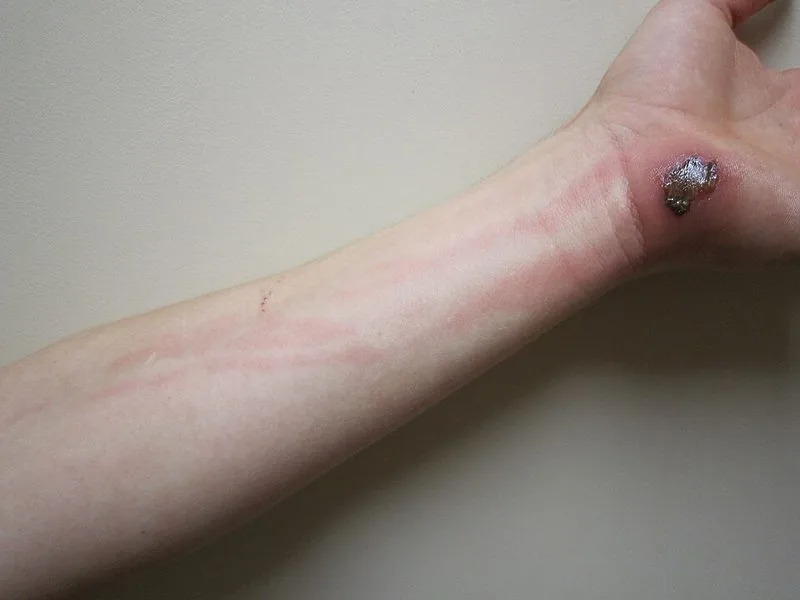
The most common causes are Streptococcus and Staphylococcus aureus bacteria (including MRSA in some cases). You may be at higher risk if you have:
- Breaks in the skin — cuts, wounds, insect bites, athlete's foot, or eczema
- Swelling in the legs (lymphedema or poor vein circulation)
- Obesity or diabetes
A related condition called erysipelas is a more surface-level skin infection. It has a sharp, raised, shiny red border and usually appears on the lower leg or face.
Cellulitis is diagnosed based on how it looks and your symptoms — not blood tests. Blood cultures come back positive in fewer than 4% of cases. The more important concern is making sure it is not something more serious, like necrotizing fasciitis (a fast-spreading, life-threatening deep tissue infection that can look like cellulitis early on).
Our board-certified provider evaluates potential cellulitis through video and photo review, along with a detailed history. To help with your visit:
- Take photos of the red area, ideally with the borders outlined in pen to track whether it spreads
- Note how fast the redness is growing
- Be ready to share your fever status, prior similar episodes, diabetes history, immune health, and any history of MRSA
Your provider will use clear clinical criteria to decide if you can be safely treated at home with oral antibiotics, or if you need in-person or emergency care instead.
Clinical Features of Cellulitis We Evaluate
Spreading Erythema
Red, warm, tender area — photos with outlined borders enable spread monitoring
Localized Swelling & Edema
Induration and swelling of affected limb; bilateral swelling more likely venous insufficiency
Low-Grade Fever
Mild fever (<101.5°F) compatible with localized infection; higher fever warrants ER
Portal of Entry Assessment
Tinea pedis, skin wounds, insect bites, dermatitis — identifying and treating the source
MRSA Risk Factor Assessment
Prior MRSA, household contacts with MRSA, healthcare exposure, IV drug use
Rate of Progression
Rapidly spreading cellulitis within hours — hallmark of severe infection, ER referral
Treatment Response at 48–72 Hours
Lack of improvement or worsening on oral antibiotics = in-person evaluation required
Comorbidity Review
Diabetes, immunosuppression, lymphedema — higher risk for severe/refractory cellulitis
Antibiotics for Cellulitis & Telehealth Limitations
For mild-to-moderate cellulitis without pus, fever, or serious health conditions, oral antibiotics taken at home are the standard treatment. First-line options per IDSA guidelines include:
- Cephalexin 500 mg four times daily for 5–7 days
- Dicloxacillin 500 mg four times daily for 5–7 days
- Clindamycin — an alternative if you are allergic to penicillin-type antibiotics
- TMP-SMX (Bactrim DS) — used when MRSA is a concern (prior MRSA, abscess present, healthcare exposure, or failed first-line antibiotics)
Important telehealth limitations: There are things a virtual visit cannot fully assess. These include:
- Abscess — a pocket of pus that needs to be drained, not just treated with antibiotics. This requires a hands-on exam to detect.
- Deep tissue infections (necrotizing fasciitis, gas gangrene) — these need in-person exams, lab work, and often imaging (CT or MRI).
- Blood clot (DVT) — a common mimic of cellulitis that causes similar redness, swelling, and warmth in one leg. It requires an ultrasound to rule out and is treated with blood thinners, not antibiotics.
Your provider will assess the severity of your cellulitis using established IDSA criteria. Mild cases (no fever, no serious health issues) can be safely managed via telehealth. More severe cases — with fever, rapid spread, or weakened immune system — need in-person care, and your provider will direct you immediately. A follow-up within 48–72 hours is recommended for all telehealth-managed cellulitis. If you are not improving, you will need an in-person evaluation.
Emergency Warning — Go to the ER Immediately If You Have
These features may indicate necrotizing fasciitis, gas gangrene, sepsis, or DVT — life-threatening conditions that require immediate in-person emergency care. Do not wait for a telehealth visit:
- CALL 911: Rapidly spreading redness within hours — cellulitis that has grown significantly since you first noticed it, especially if crossing joint lines
- CALL 911: Skin blistering (bullae), skin color changes to gray/black, or skin that looks necrotic — classic features of necrotizing fasciitis. This is a surgical emergency with significant mortality.
- CALL 911: Severe pain disproportionate to visible skin changes — a red flag for necrotizing fasciitis where deep tissue infection precedes visible skin changes
- • High fever (above 102°F), shaking chills, rapid heart rate, confusion — signs of sepsis
- • Facial or orbital cellulitis (redness and swelling around the eye or face)
- • Cellulitis in an immunocompromised patient (HIV, chemotherapy, organ transplant, diabetes with A1C >9)
Cellulitis — Frequently Asked Questions
How does an InnoCre telehealth visit work?
After you book, you complete a short intake form, then connect with a board-certified provider by video on the same day in most cases. The provider reviews your symptoms and history, orders lab work at a local lab if needed, and sends any prescription to the pharmacy of your choice. A new-patient visit is a flat $68 with no insurance required.
You May Also Need
Get Your Skin Infection Evaluated Today
Same-day cellulitis evaluation with clear clinical guidance. Serving PA, MD, WA & DE.
Book Your Visit Now →Serving DE · MD · WA | HIPAA-Compliant | Board-Certified
Related Blog Articles