Eczema Treatment Online
Itchy, inflamed, flaring eczema? Get expert atopic dermatitis management including topical steroids, tacrolimus, emollient therapy, and trigger identification — without leaving home.
Understanding Atopic Dermatitis — Pathophysiology & Triggers
Atopic dermatitis (AD) is a chronic, relapsing inflammatory skin condition affecting about 31 million Americans. It is the most common form of eczema. Three features define it: skin barrier dysfunction, immune dysregulation (a Th2-skewed immune response), and intense itching (pruritus).
Mutations in the filaggrin gene (FLG) — a structural protein essential to the skin barrier — are among the most well-established genetic risk factors. These mutations lead to increased water loss through the skin, dryness (xerosis), and greater sensitivity to irritants and allergens. AD often shows up alongside asthma and allergic rhinitis — the so-called "atopic triad."
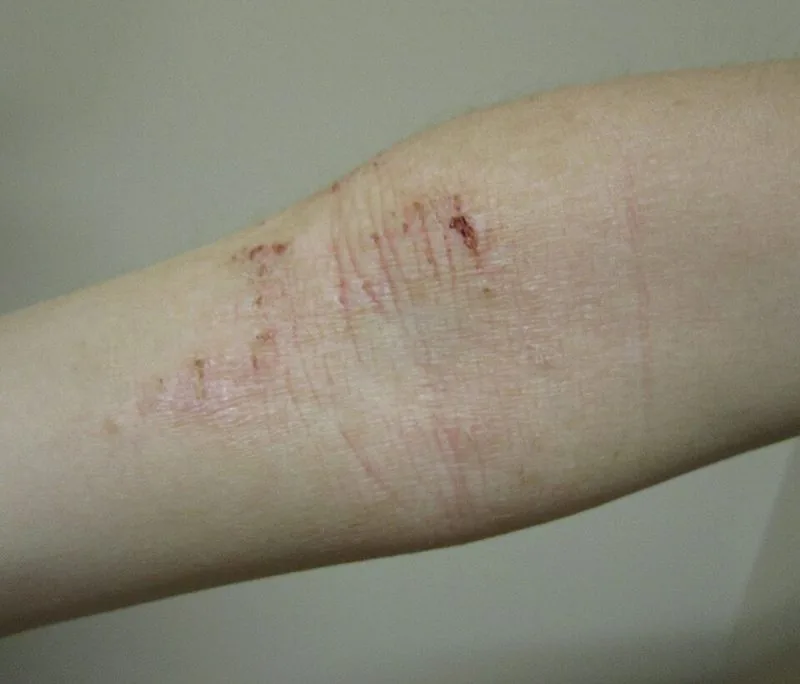
The itch-scratch cycle is a central feature of atopic dermatitis and one of the most burdensome parts of the disease. Itching — often worse at night — drives scratching, which damages the skin barrier, lets in pathogens, and keeps inflammation going. Breaking this cycle is a primary treatment goal.
Identifying personal triggers is equally important. Common ones include:
- Fragrances and preservatives in soaps and lotions
- Wool and synthetic fabrics
- Hot showers and sweat
- Certain foods (in some patients, particularly children)
- Stress
- Environmental allergens such as dust mites and pet dander
- Extremes of temperature
Where eczema shows up varies by age and how long it has been present. In adults, AD typically affects the flexural areas — inner elbows, behind the knees, wrists, neck, and around the eyes. It may also show lichenification (skin thickening from chronic scratching) and excoriations (scratch marks). Your board-certified provider assesses extent and severity during your telehealth visit using validated tools such as the Eczema Area and Severity Index (EASI), adapted for video visits through photo submission and a structured symptom review.
Eczema Treatments Available Online
Emollient Therapy (Cornerstone)
Thick creams/ointments (Vanicream, CeraVe, Eucerin) applied within 3 minutes of bathing
Low-Potency Topical Corticosteroids
Hydrocortisone 1–2.5% — for face, eyelids, and skin folds; safe for sensitive areas
Mid-Potency Topical Steroids
Triamcinolone 0.1% — for trunk and extremities; limit continuous use to 2–4 weeks
High-Potency Topical Steroids
Clobetasol 0.05% — reserved for severe, short-term flares; avoid face and skin folds
Topical Calcineurin Inhibitors
Tacrolimus (Protopic) 0.03–0.1% and pimecrolimus (Elidel) — steroid-sparing, safe for face
Antihistamines for Pruritus
Sedating (diphenhydramine, hydroxyzine) for nighttime itch; non-sedating for daytime
Trigger Identification & Avoidance Plan
Personalized review of environmental, dietary, and lifestyle triggers driving flares
Wet Wrap Therapy Guidance
Technique instruction for severe flares — wet followed by dry dressing over topical steroids
Topical Corticosteroid Potency — Getting It Right
One of the most common errors in eczema care — and a major driver of treatment failure — is under-treating with a steroid that is too weak. Ironically, this prolongs the disease and increases total steroid exposure. AAD guidelines and the National Eczema Association both emphasize using the right potency, on the right body region, for the right duration.
- Low-potency (Class VI–VII, e.g. hydrocortisone 1%) — sensitive areas like the face, eyelids, underarms, and groin.
- Mid-potency (Class III–V, e.g. triamcinolone 0.1%) — the workhorse for trunk and extremity disease.
- High-potency (Class I–II, e.g. clobetasol 0.05%) — reserved for palms, soles, and short-term severe flares on non-sensitive sites.
Topical calcineurin inhibitors — tacrolimus (Protopic) and pimecrolimus (Elidel) — are non-steroidal options that calm the immune response. They are especially valuable for areas where long-term steroid use carries the greatest risk of side effects: the face, around the eyes, and skin folds. They carry a black box warning about a theoretical cancer risk (not established in clinical evidence). The AAD still recommends them as steroid-sparing options for maintenance and sensitive sites. Tacrolimus 0.1% is the stronger version for adults; 0.03% is used in children.
For patients with moderate-to-severe atopic dermatitis that does not respond to topical therapies, dupilumab (Dupixent) — an IL-4/IL-13 receptor antagonist biologic — is a major advance. It is highly effective and has a favorable safety profile. However, it requires injections, specialty pharmacy coordination, and shared management with a dermatologist. InnoCre identifies patients who may be candidates for dupilumab and helps speed up the process with a dermatology referral that includes the relevant clinical documentation.
Emergency Warning — Eczema Herpeticum
Eczema herpeticum (Kaposi varicelliform eruption) is a serious complication of atopic dermatitis caused by herpes simplex virus (HSV) superinfection of eczematous skin. It is a medical emergency requiring urgent in-person evaluation and systemic antiviral treatment.
- URGENT: Sudden widespread worsening of eczema with clusters of punched-out, monomorphic vesicles or erosions — especially on the face, neck, or trunk
- URGENT: Fever, malaise, and lymphadenopathy accompanying an eczema flare — systemic HSV spread
- • Painful rather than itchy lesions that appear different from usual eczema pattern
- • Do not apply topical steroids to possible eczema herpeticum — go to urgent care or ER for systemic acyclovir
Related Articles
Eczema Treatment — Frequently Asked Questions
How does an InnoCre telehealth visit work?
After you book, you complete a short intake form, then connect with a board-certified provider by video on the same day in most cases. The provider reviews your symptoms and history, orders lab work at a local lab if needed, and sends any prescription to the pharmacy of your choice. A new-patient visit is a flat $68 with no insurance required.
You May Also Need
Get Your Eczema Under Control Today
Expert eczema management via same-day telehealth. Serving PA, MD, WA & DE.
Book Your Visit Now →Serving DE · MD · WA | HIPAA-Compliant | Board-Certified